

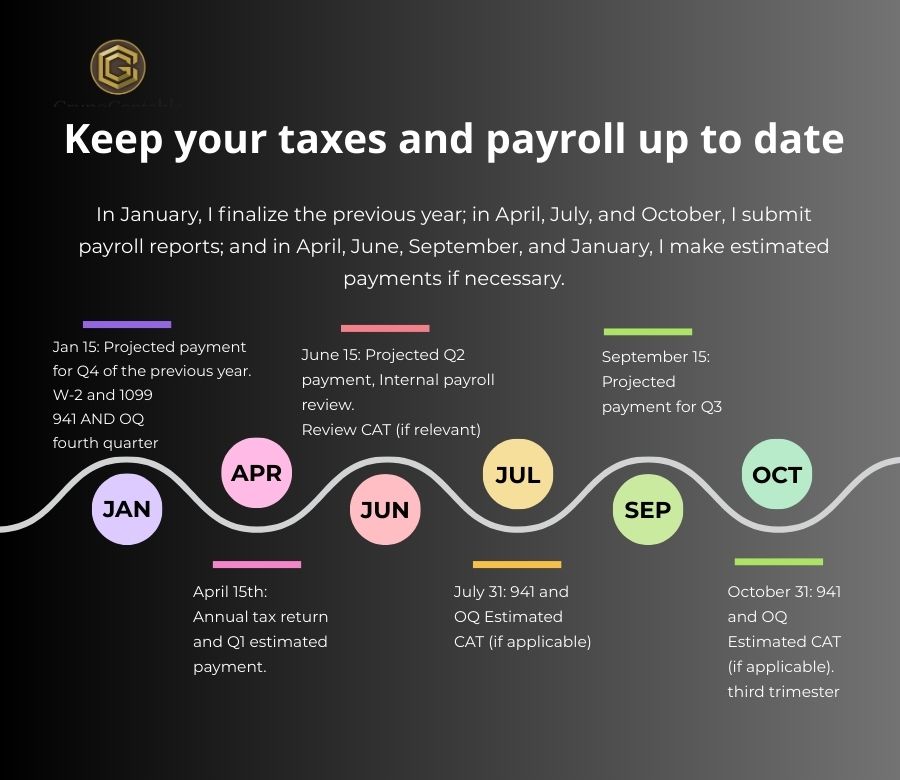
Why this calendar matters
- Avoid late-payment penalties and interest, reduce stress during the year and protect and improve your cash flow.
- Align accounting, payroll, and taxes into a predictable routine.
If you own a business or work for yourself, there are certain key dates that repeat every year:
- In January, you close the previous year.
- In April, July, and October, you report quarterly payroll.
- In April, June, September, and January, you make federal estimated tax payments (if required).
Staying on top of these dates helps you avoid penalties and keeps your taxes, payroll, and reports up to date
Quick vocabulary guide:
- Federal estimated tax payments: Quarterly prepayments of income tax.
- Information returns: Forms like W-2 (employees) and 1099-NEC (vendors/independent contractors).
- Federal payroll report: Form 941 (quarterly) or Form 944 (annual, if the IRS assigns it).
- Oregon quarterly OQ: The Combined Payroll Tax Report (state withholding, unemployment taxes, etc.).
- Oregon CAT (Corporate Activity Tax): Applies to businesses whose commercial activity exceeds certain thresholds (registration and estimated payments may be required).
Month-by-month checklist
January
- Issue W-2 and 1099-NEC no later than January 31 (to recipients, SSA/IRS, and to Oregon via iWire when required).
- File Form 941 (Q4), Oregon OQ (Q4), and related payroll reports by January 31.
- If applicable, file annual Form 940 (FUTA).
- Review your estimated tax schedule for the new year.
February – March
- Close the prior year’s books and prepare documents for tax returns.
- Check your status for the Oregon CAT: did you exceed any thresholds? Do you need to register or make estimated payments?
- Organize documentation for deductions and credits (invoices, receipts, mileage, depreciation schedules, etc.).
April
- April 15: Federal Q1 estimated tax payment and typical due date for individual federal income tax returns (if you don’t request an extension).
- April 30: File Form 941 (Q1) and Oregon OQ (Q1).
- CAT payments/estimates (if applicable): due April 30.
May – June
- June 15: Federal Q2 estimated tax payment
- Perform an internal payroll audit (Employee vs. contractor classification, overtime, withholding and benefit deductions).
- Review CAT status and income projections for the rest of the year.
July
- July 31: File Form 941 (Q2) and Oregon OQ (Q2).
- CAT estimated payments (if applicable): due July 31.
August – September
- September 15: Federal Q3 estimated tax payment.
- Mid-year review of: Books and reconciliations, Inventory, Depreciation and Expense controls and budget vs. actuals.
October
- October 31: File Form 941 (Q3) and Oregon OQ (Q3).
- CAT estimated payments (if applicable): due October 31.
- Begin preparing for W-2/1099 season: verify addresses and TIN/ITIN/SSN information.
November – December
- Perform a preliminary year-end close: reconciliations, inventory counts, and physical stock checks (if needed).
- Review bonuses, special payments, and final payroll run to confirm proper withholding.
- Implement last-minute tax planning: necessary expenses, depreciation decisions, and other timing considerations.
Best practices to avoid penalties
- Separate personal and business accounts.
- Reconcile bank and credit card accounts monthly or even bi-weekly.
- Maintain solid document control: contracts, invoices, receipts, payroll reports, and tax filings.
- Confirm each worker’s status (employee vs. contractor) and keep W-4/W-9 forms up to date.
- Review transit taxes and Oregon CAT if your location and revenue levels make them applicable.
- Prepare W-2/1099 forms in advance: start in November, not in the last week of January.
- Use a shared calendar with reminders for owners, managers, and your accountant or advisor.
A disciplined calendar reduces errors, prevents late fees, and strengthens your business’s financial health. When you integrate bookkeeping, payroll, and tax compliance, and maintain clear communication with your advisor, you’re far more likely to reach every deadline calm, prepared, and in full compliance.